


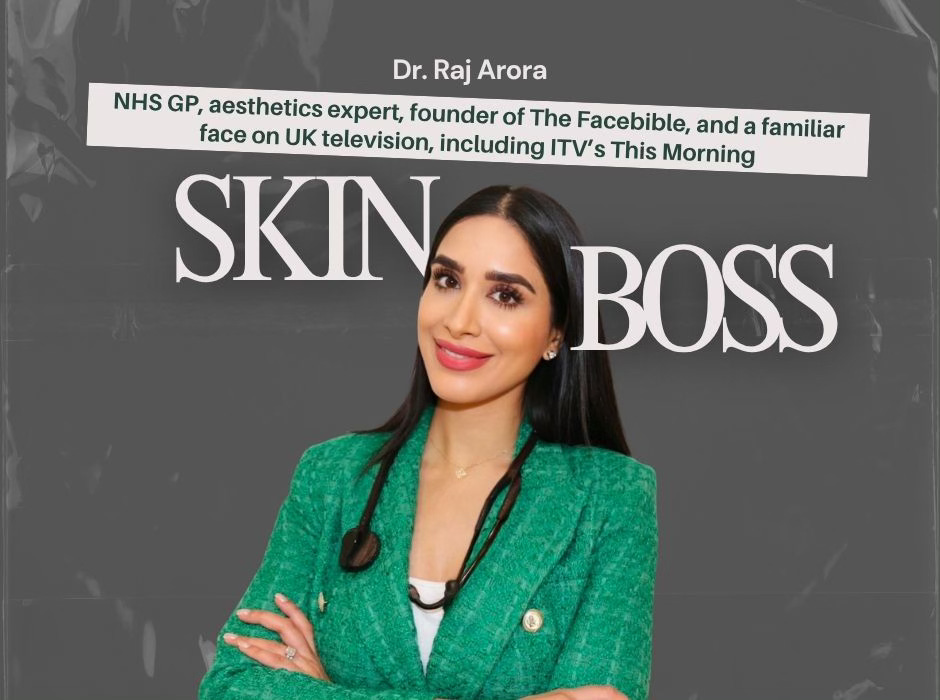
Every now and again, The Beauty Breakfast Club will sit down with a woman who has substance behind her success. Someone who is reshaping the beauty and wellness space with expertise, credibility, and purpose. This month, that woman is Dr. Raj Arora, NHS GP, aesthetics expert, founder of The Facebible, and a familiar face on UK television, including ITV’s This Morning.
I’ve known Raj for years, and what has always stood out about her is the balance between being a beauty expert, a mentor, an educator, a mother, an advocate, and still a human being with humor, warmth, and empathy. She is the doctor patients trust with their health, their skin, and their insecurities, and she approaches all three with equal seriousness.
For those who haven’t met her yet, this is your introduction.
For anyone who doesn’t know you yet - how would you introduce yourself in your own words?
A passionate doctor (GP) with special interest in women’s health and skin health. Founder of luxury private health and aesthetics clinic - The Facebible. I am also a leading health educator and a keen philanthropist. I feel fulfilled when I am encouraging patients (and my followers) to make informed health decisions about their emotional and physical wellbeing. My goal is to empower my patients with evidence based knowledge and to bust dangerous misinformation online.
We’ve been friends for years, and I’ve seen your journey firsthand - but for our readers, can you walk us through how your career has evolved from traditional GP to becoming the go-to doctor for more or less everything?
Here’s to our friendship! Being a traditional GP in the UK is a rewarding and fulfilling job when you get to be the “family doctor”. So initially that drew me in, helping patients and their families to live healthy lives.
The landscape has changed a lot in the last decade and unfortunately being a traditional GP has lost it’s flair in the sense that there is no longer such a community feel. I initially branched away into private general practice so that I could regain some of that autonomy and have longer appointments for my patients. I love practising as a family doctor in the private field.
I decided to combine this with skin health and aesthetics as a “one stop shop”. I feel privileged that patients trust me with their health, their skin and their appearance. I still work as an NHS GP because I believe in the values of the NHS as an institution, even though the challenges and pressures are very different now.
What pulled you into medicine in the first place? Was it always the plan, or did something shift along the way?
Interestingly, I was always a keen economist. I was naturally good at numbers and understanding the macro and micros of the economy. However, even as a teenager, if something didn’t challenge me enough, it wasn’t appealing to me.
I found myself switching my UCAS applications at the last minute into medicine. Medicine seemed unattainable, challenging and exciting. My career tutors were shocked and most of them advised me against it, as most applicants had been preparing for years – but I secured myself a med school place that very year and here I am!
You’re a GP, you’ve got your own skin clinic, you’re on national TV, and you’re breaking down derm jargon on social. What does a typical day even look like for you?
Yes – I am a bit of a busy bee but I do like the variety of my working week. No two days are typically the same. I wake around 5 am most mornings to give a milk feed to my baby girl and then start with getting my son ready for school! I then try to fit in a quick work out if possible 30-40 mins and head straight to clinic. Clinic will usually comprise of either a full NHS GP surgery or a Private clinic day where I usually have a combination of health, skin and aesthetic appointments.
On my media days I am either recording and editing media or I am in studios for the live TV health segments. I unwind in the evenings with my family and just like any other parent I am busy with school picks up, dinner and bed time routines between 6-9pm. I usually get a little time to catch up with my husband, Sanjay, we connect and have a debrief of the day. Some evenings I have networking or brand events but I try to keep these to a minimum as I love to spend time with Family in the evenings!
I’ve known you for years and seen you evolve over the years - what do you think has changed the most about you as a doctor and as a woman in the industry?
As a doctor, I have seen my focus shift towards preventative health and wanting to educate my patients with the facts. There is so much misinformation online. My clinics typically run late as I like to spend longer than allocated with each patient – answering their questions and referring them to resources. For me, patient autonomy is very important. Patients should be able to have the freedom to make informed decisions about their health.
I have found myself wanting to educate on my platforms and to use my voice as an Indian doctor to reach people from ethnic minority backgrounds also. As a woman in the industry, I have become more confident in myself, I realise that not everyone will be your cup of tea and you won’t be liked by everyone either. It is key to remember that there is a place for everyone and this is what keeps me secure and allows me to make genuine connections. I focus on my work as a doctor and I give time to my passions – philanthropy, education and creating beautiful memories with my family. These fulfil me beyond measure.
Let’s be real: there’s a lot of bad skin advice online. As an actual doctor, how do you stay calm when someone with no credentials (or even with credentials) starts handing out skincare advice that you feel is wrong?
Honestly, I used to get really wound up about it. The irresponsibility of sharing misinformation online and being ok with young people following the wrong advice and ruining their skin as a result – it just shocks me that content creators are ok with that! Now I have found my own way to deal with this – through action – calling out misinformation and creating a space where evidence based information exists. Knowledge is power to make informed decisions but the correctknowledge is key.
Do you ever get backlash or side-eyes from the medical community for how visible you are online? How do you deal with that?
There was a time nearer lockdown when I first started creating content online that I think there was definitely some “side eye” for deviating from more traditional forms of sharing medical information (papers/lectures) and teaching. However, In the past 4-5 years there has definitely been more of a shift and acceptance in using social media as a means to educate but also to reach the public when it comes to sending out health messages and calling out health misinformation. I have since worked with NHS and certain health trusts to amplify health messaging through social media.
You’re the reason I’m on tretinoin and my skin thanks you every single day - for anyone still scared of it, what’s your advice?
Retinoids are a game changer but you have to know your skin and which form will work best for it. Using a low strength and building up tolerance and frequency is key. If used correctly, retinoids can give you the glowiest skin – Nina you are an advert for that!!!
SPF…do people still need convincing? Please answer this long debated question: in what order do you apply it with moisturizer, serum/treatment, primer, foundation etc?
Sadly yes – there is still a lot of work to be done to bust the myths and misinformation around sunscreen use. SPF should always be the last step in your skincare routine, use it after all serums and after moisturiser if you are using one. The best SPFs leave the skin feeling moisturised but non – greasy ! makeup application on top of spf please!
What’s a common skincare mistake that kind of makes your blood boil?
Using a foundation with a sunscreen – spf rating 10 – I don’t know whether to laugh or cry when patients tell me they are using a combination spf/foundation with a low rating!!
Do you ever feel pressure to ‘have it together’ all the time because of your platform? How do you stay grounded?
Yes there is always a pressure especially when having a platform that serves many different groups of people. You always feel the need to show up and to remain resilient and focussed. However, I have learnt over time to share vulnerabilities too, as this makes us human, relatable and also grounds us. Spending time with my family, taking time offline and scheduling time to myself is key in allowing me to be at my most efficient and resourceful self when I am in “work mode”.
QUICKFIRE ROUND
• Best skincare investment? My LED light mask!
• One ingredient people are completely misusing? Beta hydroxy acids
• A skincare product you’d happily ban forever? ST IVES APRICOT SCRUB !!
• Go-to hangover cure that actually works? BLT sandwich and a fizzy drink!
• One thing patients always lie about? Using spf!
• Skincare product that’s pure scam? WIPES!!!
• Pet peeve as a GP? PEOPLE NOT TURNING UP FOR THEIR GP APPT – AT LEAST CANCEL OR RESCHEDULE.
• Most ridiculous DM you’ve ever received? That I am spreading misinformation when asking patients to attend their cancer screening
• What would your patients never guess about you? That I loveeeee to sing and dance around my bedroom. Yes I am that girlie!!
This is what makes Dr. Raj Arora stand out: she’s not trying to be a “skin influencer.” She’s a physician using her platform to protect, educate, and empower. Her work proves that beauty and health don’t need to be separate conversations. She treats the whole person, medically, emotionally, and aesthetically, and she does it with empathy and purpose.
I really do hope you’ve taken away what I have from this…knowledge matters. Prevention matters. And women deserve better information, better care, and better representation.
You can follow Dr. Raj Arora here on Instagram.
Great interview!